
Electrical Component Assembly: High capacity production lines
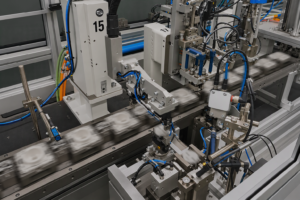
How to set up a high-capacity production line for assembling electrical components
The electrical component assembly industry is evolving towards more complex products, with increased electronic content, a wider variety of references and shorter product life cycles. At the same time, trends such as electrification, smart infrastructure and the growth of data centers are driving demand for energy protection, distribution and control devices.
In parallel, manufacturers face challenges such as skilled labor shortages, rising labor costs and the need for greater flexibility and production capacity. As a result, companies involved in electrical component assembly must find ways to increase output while maintaining quality, flexibility and operational efficiency.
In this context, the key question is no longer only how to reduce the cost per unit, but how to increase production capacity in electrical component assembly lines without compromising quality, reliability or machine availability.
Cycle Time and Real Production Capacity in Electrical Component Assembly
Cycle time is one of the most important factors influencing the production capacity of electrical component assembly lines. However, optimizing cycle time is not simply about increasing the speed of individual stations. It requires identifying bottlenecks, balancing processes and ensuring stable performance under real production conditions.
Although the relationship between cycle time and theoretical output is direct, the actual capacity of an electrical component assembly operation also depends on availability, product quality and the ability to sustain performance over time. Factors such as component feeding issues, variable process times, micro-stoppages, lengthy changeovers or maintenance constraints can significantly reduce effective production output.
For this reason, the optimal cycle time is not necessarily the fastest one, but the cycle that can be maintained consistently while meeting the required quality standards and OEE targets. In high-speed electrical component assembly lines, even small improvements can have a significant impact, provided they do not compromise process reliability or equipment availability.
Balancing the Line to Increase Production Capacity
Production capacity improvements are often achieved through measures such as:
- Performing operations in parallel.
- Feeding multiple components simultaneously.
- Eliminating non-value-added movements.
- Integrating inspections into existing operations.
- Adapting product designs to simplify assembly.
In addition, the line architecture must be aligned with production volumes and the required level of flexibility. While a dedicated solution may be suitable for a stable, high-volume product, modular or robotic platforms often deliver greater value when manufacturers need to manage multiple variants or anticipate future product changes.
There is no single technology that fits every scenario. The most appropriate solution for electrical component assembly will depend on the product, expected demand and the anticipated evolution of the manufacturing process throughout the equipment’s lifecycle.
Component Feeding: A Key Factor in Electrical Component Assembly Capacity
In electrical component assembly lines, a significant share of productivity losses originates in component feeding and positioning systems. Components often feature complex geometries, multiple possible orientations or manufacturing variations that can affect the stability of the production flow.
When the feeding system does not operate reliably, the actual capacity of the electrical component assembly process is compromised, regardless of the nominal speed of the stations.
For this reason, the selection of technologies such as vibratory feeders, flexible feeding systems, machine vision or robotics should take into account factors such as:
- Component stability and variability.
- Required autonomy.
- Risk of jams or accumulations.
- Changeover time.
- Ease of cleaning, adjustment and recovery after stoppages.
Component feeding should not be considered a secondary design element, but rather a critical technology for ensuring the capacity, autonomy and operability of the entire electrical component assembly line.
Operability: A Key Factor in Maintaining Productivity
The capacity of an electrical component assembly line does not depend solely on its technical performance. It is also influenced by how easily production and maintenance teams can operate, adjust and recover the system.
A technically advanced machine that is difficult to use can lead to productivity losses during changeovers, unplanned stops or maintenance interventions. For this reason, operability should be considered from the design stage, with particular attention to aspects such as:
- Accessibility for adjustment and maintenance.
- Component replenishment without disrupting production.
- Guided and simplified changeovers.
- Recipe and parameter management.
- Clear alarm diagnostics and rapid recovery procedures.
The objective is to simplify operation without compromising performance, enabling electrical component assembly processes to maintain stable productivity and long-term efficiency.
Flexibility and Scalability for Future Growth
Manufacturers in the electrical component assembly industry need production lines that combine productivity and flexibility. Increasing product variety, greater electronic content and growing customization requirements make adaptability just as important as production speed.
When designing a future-ready solution for electrical component assembly lines, it is important to consider factors such as:
- Changeover time.
- Reduction of manual adjustments.
- Reuse of common stations.
- Automatic recipe and format management.
- Integration of new product variants.
- Demand growth and future capacity expansions.
The goal is to achieve the right balance. An overly rigid solution can limit product evolution, while excessive flexibility may unnecessarily increase investment costs and system complexity.
In addition, a production line should not be designed solely around initial manufacturing requirements. Since equipment often remains in operation longer than many of the products it was originally built for, manufacturers must also consider future scenarios such as increased demand, new product introductions, component changes and additional inspection requirements.
Designing scalability from the outset makes it possible to reserve space, interfaces and control capacity for future expansions, allowing new stations, technologies or processes to be integrated with a lower impact on production and investment.
To achieve the right balance between capacity, quality, flexibility and scalability, it is essential to work with a partner that has extensive experience in automation solutions for electrical component assembly processes.
The Mondragon Assembly Approach
With 50 years of experience and over 3,000 completed projects, Mondragon Assembly designs automation solutions for electrical component assembly, combining engineering expertise, component feeding, testing and traceability.
Our approach is based on:
- Expertise in processes and critical technologies: Our experience has enabled us to gain in-depth knowledge of assembly processes and the factors that influence their performance, quality, and reliability.
- Specialized knowledge in feeding technologies: We have our own department specializing in feeding systems, which develops solutions tailored to the characteristics of each component and the specific requirements of each assembly process.
- Fast and adaptable machines: We design solutions aimed at meeting demanding production cycles, with the ability to adapt to different part numbers, components, and production needs.
- Operational simplicity and ease of maintenance: We design systems with an eye not only toward performance but also toward day-to-day production, aiming to simplify operation, adjustments, and maintenance tasks, thereby reducing the operational complexity of the line.
- Support throughout the system’s entire lifecycle: from the initial definition and development of the solution through to its commissioning and ongoing support.
Thanks to this combination of experience, process know-how and innovation capabilities, we can provide high-throughput production lines while maintaining quality, flexibility, and operational efficiency in your electrical component assembly lines.
Are you looking to invest in assembly lines with high production capacity?
At Mondragon Assembly, we help electrical appliances manufacturers analyze their processes and develop electrical component assembly automation solutions designed to address today’s production challenges and support future growth.
Mondragon Assembly, leaders in high speed custom-made solutions