
PV Panel Recycling: Panel Composition and Material Recovery
PV Panel Recycling: Panel Composition and Material Recovery
Solar energy has become one of the central technologies of the global energy transition. But the rapid expansion of solar installations also brings a new industrial challenge: how to manage photovoltaic panels once they reach the end of their useful life. IRENA and IEA-PVPS projected that recycling or repurposing solar PV panels at the end of their roughly 30-year lifetime could unlock an estimated 78 million tonnes of raw materials and other valuable components globally by 2050, with recovered material value potentially exceeding 13 billion EUR if reinjected into the economy.
This is why PV panel recycling is becoming strategic topics for manufacturers, recyclers, project owners and policymakers. It is not only a waste-management issue; it is a circular-economy opportunity. When PV panels cannot be repaired or reused, recycling solar panels is the preferred option before disposal, helping to preserve resources, reduce landfill volumes and recover materials that may support future supply chains.
However, efficient PV panel recycling does not begin with a recycling machine. It begins with understanding the product itself. A photovoltaic panel is a highly engineered, multilayer structure designed to survive outdoors for decades. Before discussing mechanical, thermal, chemical, waterjet or high-value solar panel recycling processes, the first question is much simpler: what exactly is inside a solar panel, what is its solar panel composition, and how are those materials connected?
Understanding a module’s structure and the different solar panel materials it contains is essential for developing an effective solar panel recycling process. Whether the objective is material recovery, circular manufacturing or advanced PV panel recycling, knowing how the different layers interact is the first step toward maximizing value recovery.
Solar Panel Composition: More Than Just Glass and Silicon
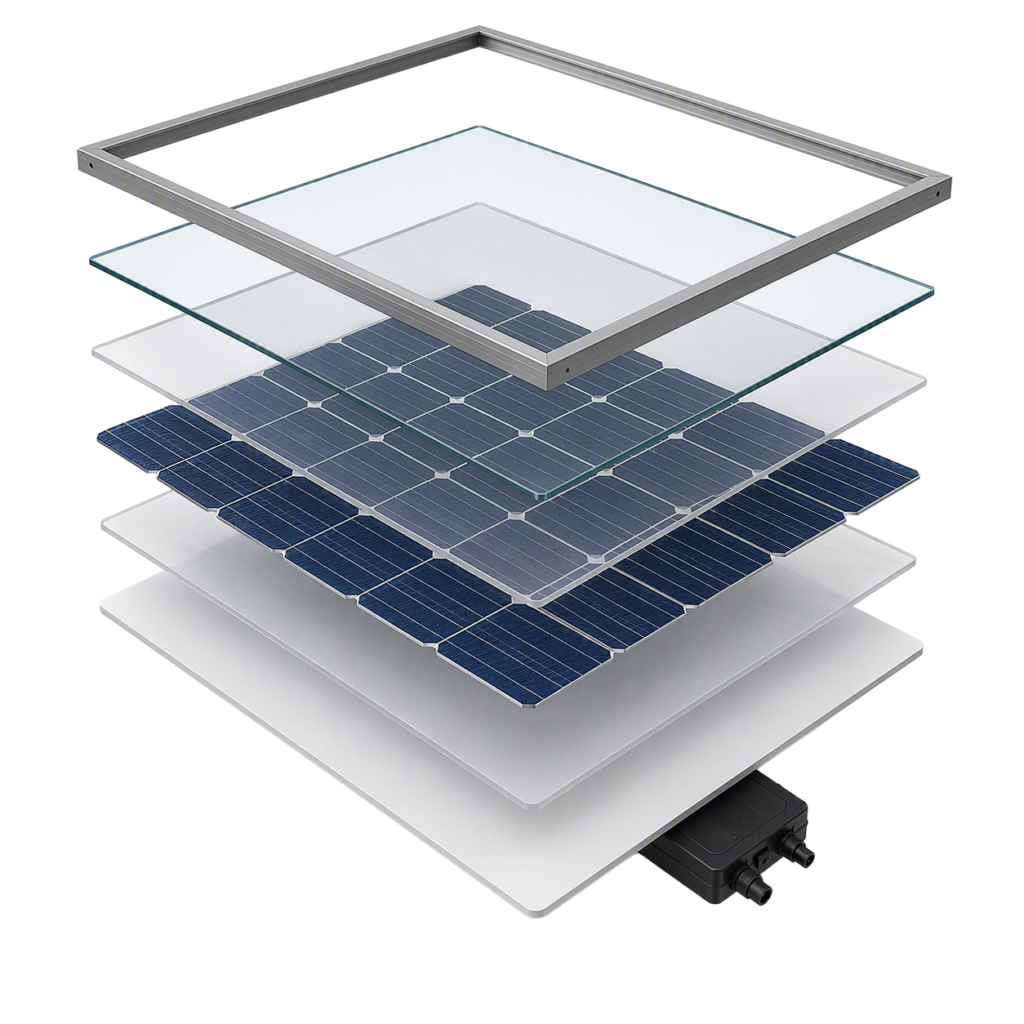
At first glance, a PV module may look like a simple sheet of glass with solar cells inside. In reality, a crystalline-silicon module is a laminated composite of glass, polymers, metals, silicon cells and electrical components. Understanding this solar panel composition is essential for developing efficient recycling strategies and maximizing material recovery at the end of a module’s life.
Crystalline silicon modules dominate the PV market, and a typical c-Si module includes an aluminium frame, tempered glass, an encapsulating layer such as EVA, silicon solar cells, a junction box, copper wires and a polymeric backsheet. In glass-glass modules, the backsheet is replaced by a second glass layer. Together, these solar panel materials determine both the performance of the module during operation and its recyclability once it reaches end-of-life.
Each layer has a specific function:
- The front glass protects the module from weather, mechanical stress and environmental exposure while allowing sunlight to reach the cells.
- The encapsulant bonds the cells and protects them from humidity and mechanical damage.
- The silicon cells convert sunlight into electricity.
- The backsheet or rear glass provides rear-side protection and electrical insulation.
- The frame, junction box and cables provide mechanical support and electrical output.
For companies involved in solar panel recycling, understanding how these materials interact within the module is the first step toward selecting the most appropriate recycling technologies and achieving high-value material recover
The Main Panel Materials Found in a PV Module
Glass
Glass is the largest component of a conventional crystalline-silicon photovoltaic panel by weight. Typical c-Si modules contain approximately 69–75% glass, making it the dominant material stream in recycling operations and one of the most important solar panel material from a recovery perspective.
Its primary function is to protect the module while transmitting sunlight efficiently to the solar cells. For recyclers, glass is important because of its volume: recovering it can significantly improve mass-based recycling rates and contribute to more efficient solar panel recycling.
In business terms, glass is the material that drives recycling volume, but not necessarily the highest economic value. High-quality glass recovery depends on keeping it as clean and uncontaminated as possible, which is a key objective in advanced solar panel recycling processes.
Aluminium Frame
The aluminium frame provides structural rigidity, protects module edges and makes installation easier. It is also one of the easiest components to remove during recycling, making it an important target in solar panel recycling operations.
From a business perspective, aluminium is attractive because it combines relatively high material value with relatively simple recovery. Among the various solar panel materials present in a module, aluminium accounts for a significant share of embedded value, while the frame is also physically accessible compared with embedded materials such as silicon, silver or copper inside the laminate.
This is why early frame removal is often one of the first steps in industrial recycling lines and in the broader solar panel recycling process: it reduces module complexity, captures value early and prepares the remaining laminate for more specialized treatment. This approach is widely used in advanced PV panel recycling strategies aimed at maximizing material recovery and operational efficiency.
Silicon Solar Cells
Silicon solar cells are the heart of the module, responsible for converting sunlight into electricity. In addition to silicon, these cells also contain small but critical amounts of silver, used in the front metallization (grid lines and busbars) to collect and transport electrical current efficiently.
Although silver represents only a very small fraction of the module’s mass, it is one of the highest-value materials within the panel. This makes its recovery particularly important from an economic perspective and a key objective in advanced solar panel recycling. However, silver is tightly integrated within the cell structure, and its extraction requires advanced separation and metallurgical processes.
Recovering silicon and silver is therefore not only about mass, it is about preserving valuable solar panel materials, and the main challenge is achieving the required purity. Current commercial recycling operations often struggle to recover silicon and silver at sufficient purity to justify the full cost of high-value recycling, especially when materials are tightly integrated and contaminated during mechanical processing.
Encapsulant (EVA/POE)
The encapsulant is one of the most important, and most problematic, materials in PV recycling. Common encapsulants include EVA, POE and other polymer systems. Their job is to bond the cells, protect them from moisture and mechanical stress, and ensure long-term module reliability.
For recycling, however, the encapsulant is often the main obstacle, a primary barrier because it strongly adheres to and protects the solar cells, making delamination difficult. Among all solar panel materials, encapsulants are often considered one of the greatest challenges for efficient separation and recovery.
This is where module design and PV panel recycling technology meet. If the encapsulant cannot be softened, cut, dissolved or otherwise separated efficiently, valuable materials remain trapped or become contaminated. For this reason, encapsulant removal is a critical step in the solar panel recycling process and a key focus area for advanced solar panel recycling technologies.
Backsheet or Rear Glass
The rear side of the module can be built with a polymer backsheet or with glass. In conventional glass-backsheet modules, the backsheet protects the module from the rear and provides electrical insulation. In glass-glass modules, a second glass sheet replaces the polymer backsheet, improving durability in many designs and supporting bifacial module architectures.
From a PV panel recycling perspective, this distinction matters. Backsheet composition is a key factor for recyclability, while glass-glass designs can remove the need for fluorinated backsheets but may create new challenges when isolating and separating different glass layers or grades. As a result, solar panel composition directly influences the treatment strategy selected by recyclers.
In other words, glass-glass modules may simplify some material concerns while complicating the mechanical separation strategy. A recycler must know whether the incoming module is glass-backsheet or glass-glass before selecting the right treatment route. This knowledge is essential for developing an efficient solar panel recycling process and improving material recovery in advanced PV panel recycling operations.
Junction Box and Cables
The junction box and cables are the electrical interface of the module. They collect and transfer the electricity generated by the cells and typically contain plastics, copper conductors and electronic components. In many solar panel recycling processes, they are removed before deeper laminate treatment because they are accessible and contain recoverable materials.
Although these parts represent a smaller share of total module mass, they matter for process design. Removing them early helps reduce contamination, recover copper-containing materials and prepare the module for the next stage of separation.
For recyclers, early removal of junction boxes and cables is an important step in the solar panel recycling process, helping to maximize recovery rates and improve the performance of advanced PV panel recycling operations.
Understanding solar panel composition is the foundation of effective recycling. Discover how Mondragon Assembly’s Waterjet technology separates and recovers valuable materials from end-of-life modules, supporting a more efficient and sustainable PV panel recycling process.
Which Solar Panel Materials Have the Highest Recovery Value?
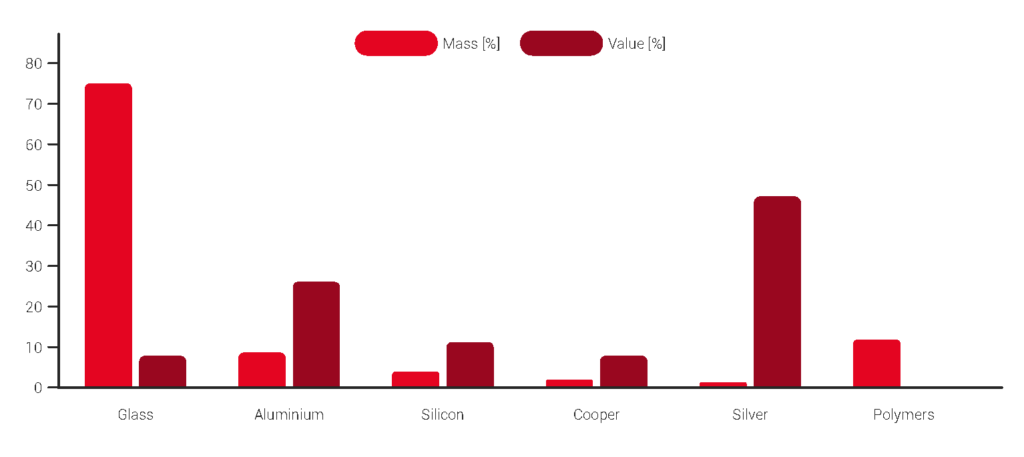
PV recycling economics are shaped by a key distinction: material volume is not the same as material value. In solar panel recycling, glass dominates module weight, but high economic value often comes from materials present in much smaller quantities.
Aluminium is one of the most attractive recovery targets because it is relatively easy to separate and has an established recycling market. Among the various solar panel materials found in a PV module, aluminium combines strong recovery potential with well-developed downstream recycling pathways.
Silicon is different. It is not abundant by mass, but it has strategic value because of the energy and manufacturing effort already embedded in the cells. High-purity silicon recovery could support circular manufacturing or other high-value applications, but the economics depend heavily on purity, contamination levels and downstream market acceptance.
A business analysis should also acknowledge silver. Silver is a critical example of the difference between mass and value: it is present only in trace quantities, but silver can account for a disproportionately large share of embedded module value. This reinforces the central point: a high-value recycling strategy must look beyond weight-based recovery and focus on purity, selectivity and market value.
For companies investing in advanced PV panel recycling technologies, maximizing value recovery requires more than simply recovering large quantities of material. The success of solar panel recycling increasingly depends on preserving the quality and market value of recovered materials throughout the recycling process.
Why Material Separation Is So Challenging in PV Panel Recycling
PV modules are designed to last, not to come apart easily. Their reliability depends on durable bonding between glass, encapsulant, cells, backsheet and frame. That design is essential for 25–30 years of outdoor operation, but it becomes a major challenge for solar panel recycling at end of life.
The most difficult part is the laminate. Once glass, encapsulant, cells, solder, ribbons and backsheet are bonded together, separating them without cross-contamination becomes technically demanding. The future recyclability of PV panels will depend not only on recycling plants, but also on how modules are designed today. This highlights the close relationship between product design and the efficiency of the PV panel recycling process.
When separation fails, value is lost. Mechanical crushing can release materials, but it can also create mixed fractions where glass, silicon, metals and polymers contaminate each other. Thermal and chemical processes can improve separation in some cases, but they may introduce energy, emissions, safety, cost or scalability challenges depending on the technology used.
How Solar Panel Composition Shapes the Solar Panel Recycling Process
There is no universal recycling strategy that fits every photovoltaic panel equally well. The correct solar panel recycling process depends on module composition, condition, construction and target recovery value.
A typical recycling sequence starts with accessible components: remove the aluminium frame, junction box and cables, then treat the remaining laminate. After that, the process may involve mechanical, thermal, chemical or hybrid delamination methods to liberate glass, polymers, cells and metals.
Solar panel composition determines the logic of the plant. If the target is mainly mass recovery, processes that recover glass and aluminium may be sufficient to meet certain weight-based requirements. If the target is high-value recovery, the process must preserve material purity and avoid creating mixed fractions that are difficult to upgrade later.
The business implication is clear: the better the knowledge of the module, the better the recycling strategy. Module composition affects equipment selection, process flow, sorting logic, output quality, operating cost and revenue potential. For companies investing in solar panel recycling and advanced PV panel recycling technologies, understanding module composition is essential for designing efficient operations and maximizing material recovery.
From Solar Panel Composition to High-Value PV Panel Recycling
The next generation of PV panel recycling will not be judged only by how much mass it diverts from landfill. It will be judged by how much value it preserves.
Current industrial practice has often focused on recovering bulk materials, but high-value solar panel recycling requires cleaner separation and more selective recovery of metals and silicon. New R&D projects are increasingly focused on delamination, metal recovery and preparation of recovered materials for markets, with technologies such as water jet, infrared lamps and other advanced approaches being explored.
High-value recycling aims to change that equation. Instead of simply breaking the panel down, it seeks to preserve the value of each material stream: clean glass for glass applications, aluminium for metal recycling, copper for smelting, and silicon and silver for higher-value recovery pathways.
For companies in the solar and recycling sectors, this is where the opportunity lies. Solar panel recycling will increasingly move from a compliance activity to a strategic raw-materials activity. Companies that invest in advanced PV panel recycling technologies and high-value recovery strategies will be better positioned to support circular manufacturing and capture greater economic value from recovered materials.
Conclusion: The First Step Towards Intelligent Solar Panel Recycling
A PV panel is more than glass and silicon. It is a durable, laminated system made of glass, aluminium, silicon cells, encapsulants, backsheets or rear glass, copper conductors, junction boxes and cables. Each component has a function during the module’s operating life, and each creates a different opportunity or challenge at end of life.
The key lesson for industry is simple: intelligent solar panel recycling begins with intelligent material understanding. Glass may dominate volume, aluminium may offer early recoverable value, silicon may represent strategic circularity potential, and silver may drive high-value recovery despite its very small mass. But none of these materials can deliver their full value if they are mixed, contaminated or downgraded during separation.
As end-of-life PV volumes grow, companies that understand solar panel composition will be better positioned to choose the right recycling technologies, design efficient processing lines, meet regulatory expectations and capture higher-value material streams. The future of PV panel recycling will not belong to those who simply process panels as waste. It will belong to those who treat them as structured reservoirs of secondary raw materials.
Solar manufacturers, recyclers, asset owners and technology providers should start now by mapping module types, improving material traceability, prioritizing clean separation and investing in high-value recovery strategies. The circular economy for PV will not be built at the end of the value chain alone, it starts with knowing exactly what is inside the module.
Understanding solar panel composition is the foundation for more effective solar panel recycling and higher-value material recovery in the years ahead.
As the PV recycling industry evolves, the focus is shifting from simple waste treatment to high-value material recovery. At Mondragon Assembly, this vision drives the development of advanced PV panel recycling solutions designed to support efficient material separation, maximize recovery value and help build a more circular photovoltaic industry.
Want to explore advanced PV panel recycling solutions? Contact our experts to discuss how innovative recycling technologies can help optimize material recovery and create greater value from end-of-life solar panels.