
Advanced recycling of solar panels: what high-value recycling is
Advanced recycling of solar panels: what high-value recycling is
From shredding to value recovery
Advanced recycling of solar panels is evolving rapidly.
As we have already seen, shredding is no longer sufficient to address the current challenges of photovoltaic recycling.
The growing volume of end-of-life panels, together with the limitations of traditional methods, focused on volume rather than value, is driving a new approach: high-value PV recycling.
But what does it really mean?
This new approach, known as high-value recycling in solar panels, focuses on maximizing the recovery of critical, high-value materials with high purity, rather than simply processing large volumes of waste.
It’s not just about recycling, but about:
- Recovering reusable silicon
- Extracting silver with real economic value
- Preserving the quality of the glass
- Avoiding material mixing that limits reuse
It represents a shift in mindset: from waste management to resource recovery.
The starting point: the limitations of shredding
Recycling based on shredding has proven to be effective as a waste treatment solution.
However:
- It generates a mixture of materials
- It limits the recovery of critical raw materials
- It reduces the quality of the recovered materials
As a result, although it enables the management of large volumes, it does not meet the goal of true circularity, where the quality of recovery is key.
For this reason, at Mondragon Assembly, we have chosen to go beyond traditional shredding by driving the development of technological solutions that enable more selective recovery with higher added value. Our approach focuses on advanced recycling of solar panels, that preserve material integrity and facilitate their efficient reuse, aligning with the principles of a truly circular economy.
What defines high-value recycling in advanced solar panel recycling
High-value PV recycling involves transforming panels into a source of critical raw materials by recovering materials such as:
- Silicon
- Silver
- Glass
with sufficient quality to be reintroduced into industry.
This approach goes beyond conventional recycling: panels are no longer seen as waste but as a secondary source of strategic raw materials.
To achieve advanced recycling of solar panels, it is necessary to work with technologies capable of:
- Selectively separating materials, avoiding mixing
- Minimizing cross-contamination
- Preserving the structure and properties of the material, especially silicon
The ultimate goal is not just to recycle, but to reintegrate these materials into the industrial value chain.
In some cases, recovered silicon can reach purity levels above 99%, enabling its reuse in new applications.
What changes compared to the traditional approach?
The key shift lies not only in the outcome, but in the process.
Compared to shredding, high-value recycling:
- Avoids mixing materials
- Enables the recovery of high-value materials
- Significantly increases the economic value recovered (from ~35% up to ~95% in advanced processes)
It represents a clear paradigm shift: from recycling waste → to producing resources.
How to implement advanced solar panel recycling: the role of technology
To enable this approach, it is necessary to work with technologies that allow for precise and non-destructive separation.
The role of waterjet
Waterjet cutting (high-pressure water jet) emerges as a key solution because it allows:
- Separation of the different layers of the module
- Prevention of material degradation
- Preservation of components such as cells intact
Its main advantages:
- Non-thermal process
- High precision
- Reduction of cross-contamination
Result: materials with higher purity and value, suitable for reuse.
From technology to industrial reality
The implementation of high-value recycling does not depend solely on technology, but on its application at an industrial scale.
This is where industrial innovation comes into play:
It is necessary to develop solutions that enable:
- Process automation
- Guaranteed repeatability
- Scaling to large volumes
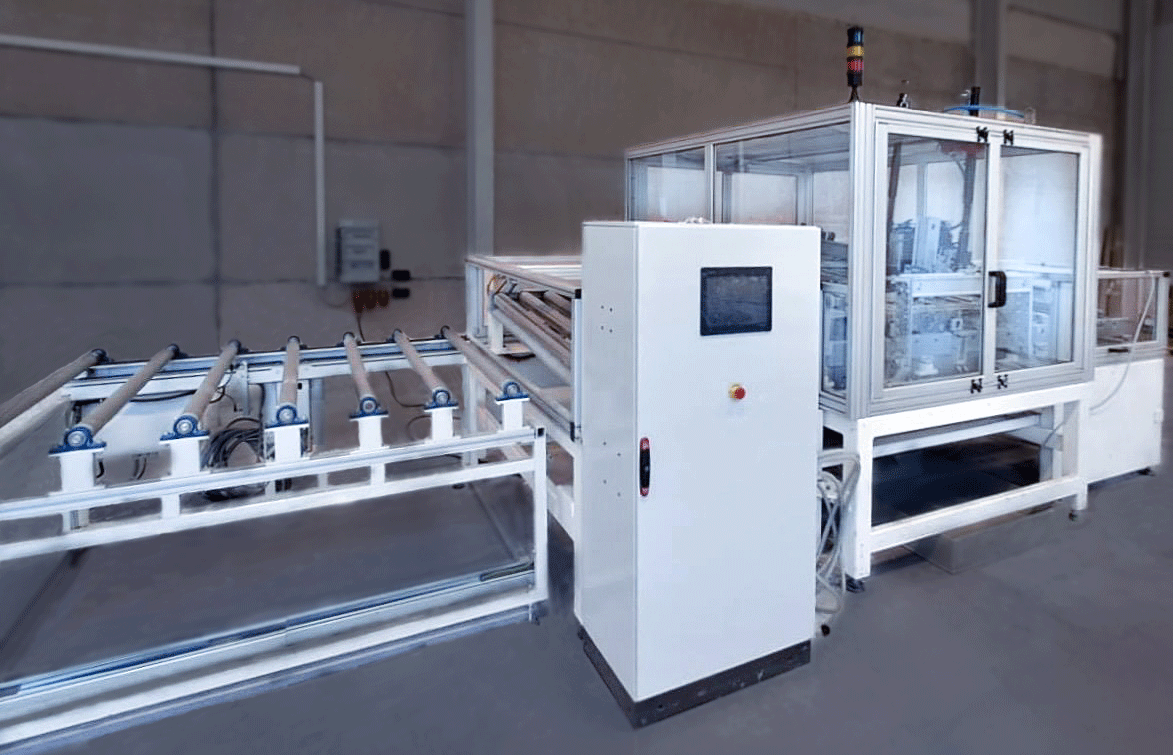
In this context, Mondragon Assembly contributes through the development of automated solutions and their industrial scaling, facilitating the adoption of these processes in real environments.
This makes it possible to:
- Respond to the growing volume of waste
- Do so efficiently
- Maximize the value recovered
Why is this approach key right now?
Advanced recycling of solar panels is critical in this context:
- Strong growth in the volume of photovoltaic waste
- Increasingly demanding regulations
- Dependence on critical raw materials such as silicon and silver
This shifts the challenge: it is no longer just about recycling, but about recovering value efficiently.
The goal is to move toward a truly circular economy, where recovered materials can be reused in high-value applications.
Conclusion: Understanding it is only the first step
Photovoltaic recycling is evolving. If shredding was the first step, high-value recycling represents the next stage.
The message is clear: it is not about recycling more, but about recovering better, turning waste into strategic resources and truly closing the value loop.
In this context, Mondragon Assembly’s contribution lies in making this shift viable at an industrial scale by developing and integrating automated solutions that enable high-value recycling to be applied efficiently, consistently, and profitably.
Because understanding the concept is only the beginning. The real challenge lies in successfully implementing it in real industrial environments.
If you are ready to take the next step, we look forward to seeing you at Intersolar Europe 2026 at Messe München (Germany), Booth A2.220.
It will be the ideal meeting point to explore new opportunities in photovoltaic recycling together.